
KEYNOTE SPEAKERS
PROGRAMME AND FIELD TRIPS

IAG Equity Statement for Joint NZGS/IAG Conference
The IAG and NZGS conference space aims to be a convivial, intellectually stimulating, inclusive, diverse, and safe space where everybody feels equally welcome. Creating such a space is the responsibility of everyone, even as we recognise that it can be quite difficult and challenging to put into practice, given complex intersections of race, Indigeneity, ethnicity, disability, neurodiversity, gender, sexuality, sex characteristics, class, caste, skin colour, age, citizenship/visa status, nationality and religion, for example...
Continue reading statement
Geographers who explore place, space and scale as sites of differences, encounters, justices and progressive political imaginaries emphasise the importance of practices that create everyday equalities. Central to equality is dignity, respect, generosity, collegiality, shared responsibility and the deferral of quick judgements.
During the conference we ask you to be mindful of these principles as we act and engage individually and collectively in often unfamiliar environments and in passionate scholarship. Proactively watch out for those who stand on the sidelines who might feel hypervisible, invisible, hurt, unsafe, harassed or discriminated against by our everyday acts and environments. It is our responsibility as geographers to ensure equity, diversity and inclusion. We welcome feedback (at the time or privately) as part of our individual and disciplinary learning.
Some suggestions for more equitable and safer spaces at the joint NZGS/IAG conference might include
When presenting, situate yourself in relation to your research interests, topic, participants, and the places in which you live and work.
In sessions, pay attention to when and how much you are speaking.
In sessions, ask generative questions with curiosity, humility and respect.
NZGS-IAG Conference 2026 Apartheid Free Zone Policy
The joint NZGS-IAG Conference 2026 is an apartheid free zone (AFZ). We commit to respecting the guidelines of the Palestinian Campaign for the Academic and Cultural Boycott of Israel (PACBI). Israel’s academic institutions are part and parcel of the ideological and institutional scaffolding of Israel’s regime of occupation, settler-colonialism and apartheid against the Palestinian people, including through the discipline of geography.
Continue reading statement
Therefore, as an academic AFZ:
We uphold PACBI’s guidelines.
We don’t have relations with complicit Israeli institutions and corporations.
We refuse to participate in any kind of academic or cultural event organized in apartheid Israel, or with its support, or that of any complicit Israeli institutions, or lobby groups.
We reject funding and any form of sponsorship from the Israeli government, complicit Israeli institutions or lobby groups for the development of our cultural activities.
We respect anti-normalization guidelines; that is, we reject any attempt to portray oppression by Israel as normal, and reject efforts to establish “normal” relations with the Israeli regime.
We don’t have financial and professional relations with international institutions or corporations complicit in Israel's genocidal, apartheid, and settler colonial regime, and as defined by the BDS movement.
We affirm our support for and commitment to the growing international movement for Palestinian rights and for freedom, justice, and equality for all.
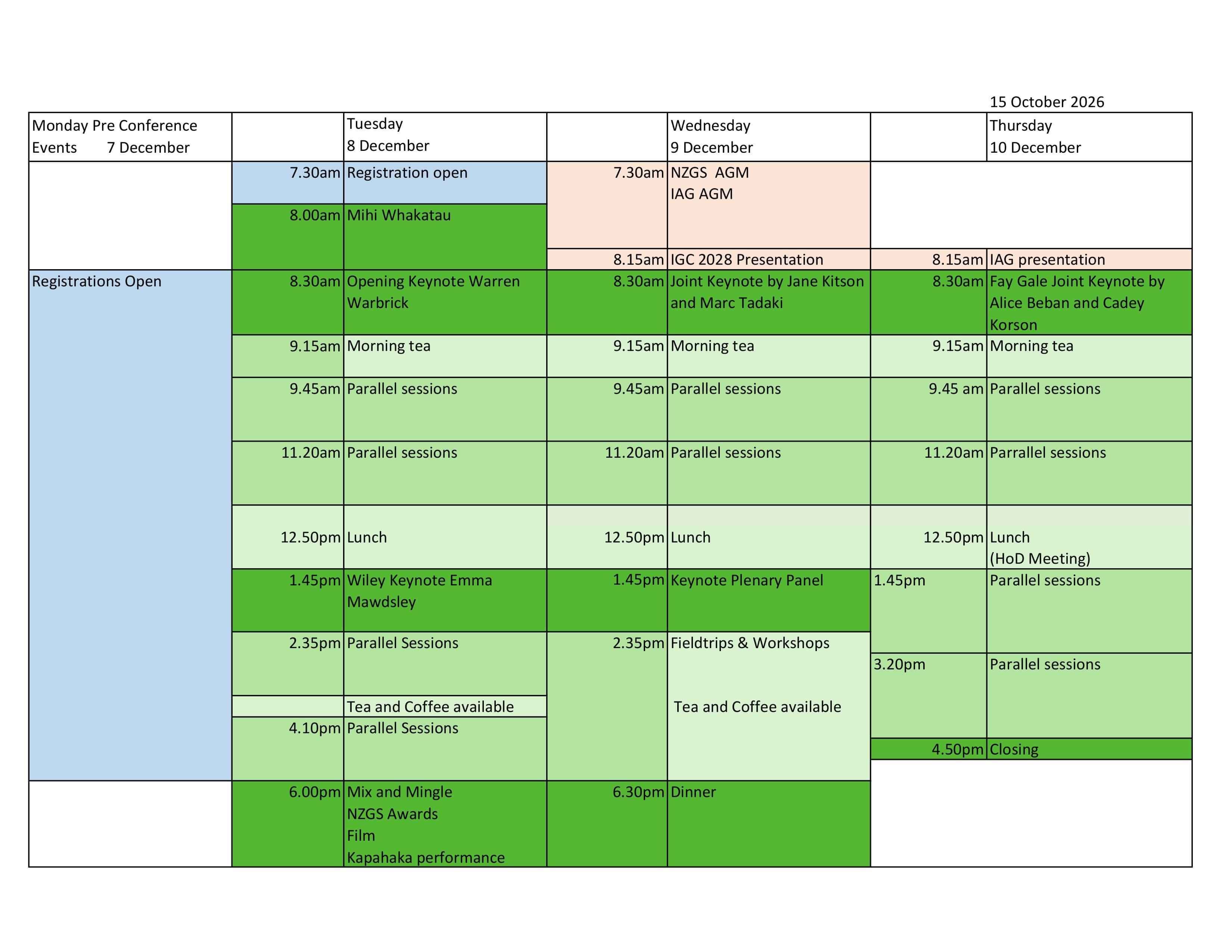
FIELD TRIPS, WORKSHOPS, & PRE-CONFERENCE EVENTS
Field trips and workshops may have limited numbers.
6 December Pre Conference Events in Pōneke Wellington
Geographers for Palestine – Connecting Places and Organising Together
Session Convenor/s: Aotearoa Geographers for Palestine and IAG Geographers for Palestine
Corresponding email for session convenors: amanda.thomas@vuw.ac.nz
Timing: Timing: 9:30am for coffee and connecting, 10am start, 4pm finish. Lunch provided. Note that this is taking place on Sunday 6 December to avoid clashing with ECR pre-conference event that is taking place on Monday 7 December. Registration fee: NZD$20 payable through conference registration.
The geographies of Aotearoa and so-called Australia are entwined with Palestine – through settler colonial structures, flows of capital, and militarism, but equally through radical traditions of organising for liberation and justice. In this workshop we will split the day between exploring these connections and participating in some facilitated organising activities that turn us towards action and strengthen the connections between our communities. The first part of the day will involve a range of speakers, from publishing groups making Palestinian political thought accessible to Aotearoa, to people connecting Indigenous struggles across space and those organising BDS campaigns. The second part of the day will be dedicated to planning for the following 18 months. By the end of the day, we will have mapped out a plan for building a committed, successful BDS movement across geography communities in Aotearoa and Australia. We invite anyone with an interest in learning more about and acting on the already-existing connections between our places and Palestine, and / or the willingness to organise for a liberated Palestine to register for this pre-conference workshop. The groups organising this workshop are committed to ending all forms of oppression, and that ethic will flow through the day.
Note that this workshop will take place in Pōneke Wellington, which is a two hour drive from Te Papaioea Palmerston North. If there is enough interest, the workshop organisers will arrange shared transport to the conference at the end of the workshop.
Key Words: Palestine, solidarity, scholar-activism
7 December Pre Conference Events in Papaioea, Palmerston North
14th Mobilities Aotearoa Symposium - "Mobilities and Work: Across Lands, Seas and Skies"
Session Convenor/s: Maria Borovnik, Massey University
Specialty Group: Mobilities Aotearoa Network
Corresponding email for session convenors: M.Borovnik@massey.ac.nz
Timing: 9.30am to 5.30pm, which we will then follow by a dinner for anyone interested joining. Abstract Submission: Please submit your abstract (maximum 250 words) to Maria Borovnik, Email: M.Borovnik@massey.ac.nz by 1 September 2026. Your submission should include your name, contact details, paper title, abstract, and a few key words. Additionally, please provide a brief (50 words) biographical note. Note that registration for this event is separate from the NZGS/IAG conference.
This year’s Mobilities Aotearoa Symposium is themed "Mobilities and Work: Across Lands, Seas and Skies". This theme acknowledges mobile occupations that are shore based, maritime related or up in the air. Invited are interdisciplinary papers that explore how work is articulated and encompassed by mobilities, which can include people, ideas, knowledge, resources, things, and/or the intersection between human and more-than-human mobilities. Topics may include but are not limited to: everyday experiences of mobile work, work and immobilities, migrant work, mobile occupations affecting health and wellbeing, mobile work and time, migrant rights and mobility justice, border crossing for work, seasonal, temporary and circulatory work, mobile work and gender, multicultural, postcolonial and racial issues in occupational mobilities, interacting with more-than-human mobilities, work and weather, work and the environment, work related mobilities and affect. Submissions are invited that present work in progress or completed research on these or similar topics. Contributors are encouraged to consider how their research builds on and contributes to the existing literature, including critical mobility studies, applied mobilities, Indigenous mobilities, mobility justice, among others.
Key Words: (im)mobilities, work and globalisation, multilocal work
5th Economic Geography Study Group Symposium - "Producing Knowledge to Shape Economic Futures"
Session Convenor/s: Nick Lewis University of Auckland, Kirsten Martinus University of Western Australia and Andrew Warrne University of Wollongong
Specialty Group: Economic Geography Study Groups
Corresponding email for session convenors: Nick Lewis(n.lewis@auckland.ac.nz), Kirsten Martinus(kirsten.martinus@uwa.edu.au), and Andrew Warren(awarren@uow.edu.au)
Timing: One day and 2 nights
The 5th Economic Geography Study Group Symposium, to be held on Monday 7 December 2026 in Palmerston North, New Zealand, co-hosted by the University of AucklandPolitics, Economy, and Place Research Network (PEP) and the IAG Economic Geography Study Group (EGSG).
The symposium has become a valued annual gathering for scholars interested in contemporary economic geography. Each year it has generated lively discussion, new ideas, and opportunities for collaboration across a broad range of research interests. The event provides a welcoming forum for established, early-career, and postgraduate researchers to share their work, build networks, and engage in critical discussions about emerging challenges and opportunities shaping economies, regions, and places.
Programme
Invited keynote speaker
Individual research presentations
Panel discussions
The symposium will also provide ample opportunities for informal networking and discussion. Thanks to generous support from our hosts and the IAG, participation includes:
Fully funded welcome dinner and drinks on Sunday 6 December
Morning tea, lunch, and afternoon tea on Monday 7 December
Post-symposium dinner for all participants
NZGS Early Career Research Network Workshop
Session Convenor/s: Ben Lilly, Heather Paterson-Shallard
Specialty Group: NZGS ECRN
Corresponding email for session convenors: ECRN Representatives nzgsecrn@gmail.com
Timing: 12.30 – 3.30pm
Details coming soon.
Community Economies Research Network
Session Convenor/s: Jenny Cameron, Bhavya Chitranshi, Katherine Gibson, Nikolai Siimes, Community Economies Research Network Aotearoa and Australia
Specialty Group: Community Economies Institute and Community Economies Research Network
Corresponding email for session convenors: jenny.cameron@communityeconomies.org
Timing: 9-12pm main session. 12-5pm for those not going to other events
Key Words: Community Economies; Hope
Nature, Risk and Resilience Study Group
Session Convenor/s: Natasha Pauli, University of Western Australia; Lisa de Kleyn, La Trobe University; Rachael Walshe, University of Canberra
Specialty Group: Nature, Risk and Resilience Study Group
Corresponding email for session convenors: natasha.pauli@uwa.edu.au
Timing: 2 hours
A pre-conference session for study group members and interested parties. The session will focus on discussing current research trends and priorities for the study group.
Legal Geography Workshop
Session Convenor/s: John Carr, Brad Jessup, University of New South Wales, University of Melbourne
Specialty Group: Legal Geography Study Group (LGSG)
Corresponding email for session convenors: john.carr@unsw.edu.au
Timing: One day
On December 7, the Legal Geography Study Group of the IAG will be hosting an informal one-day legal geography workshop in advance of the 2026 IAG/NZGS Conference in Palmerston North, New Zealand - Aotearoa, and you are invited!
The workshop will include a keynote presentation by Estair Van Wagner from University of Victoria’s Faculty of Law, who will be presenting, “From Hope to Belonging: Re-Placing Property in a More-Than-Human World.” Estair’s research explores hope in the context of urban decolonization, focusing on housing and promoting rights to housing, and in self-determination promoting reordering of property systems to increase livelihoods for Indigenous people.
Our preliminary workshop schedule currently includes:
· A round table discussion on “Hope and praxis in legal geography,”
· A workshop for experienced, early and pre-career academics to discuss their projects, papers, and career trajectories with participants who are at different stages in their careers,
· An opportunity to present research in progress and get feedback, and,
· Ample opportunity to socialize and meet informally.
We hope to see you there!
9 December Afternoon Field Trips
Register for field trips with conference registration. Due to timing, only one field trip can be taken during the afternoon.
Te Ahu a Turanga highway
Leader: Warren Warbrick (Rangitāne)
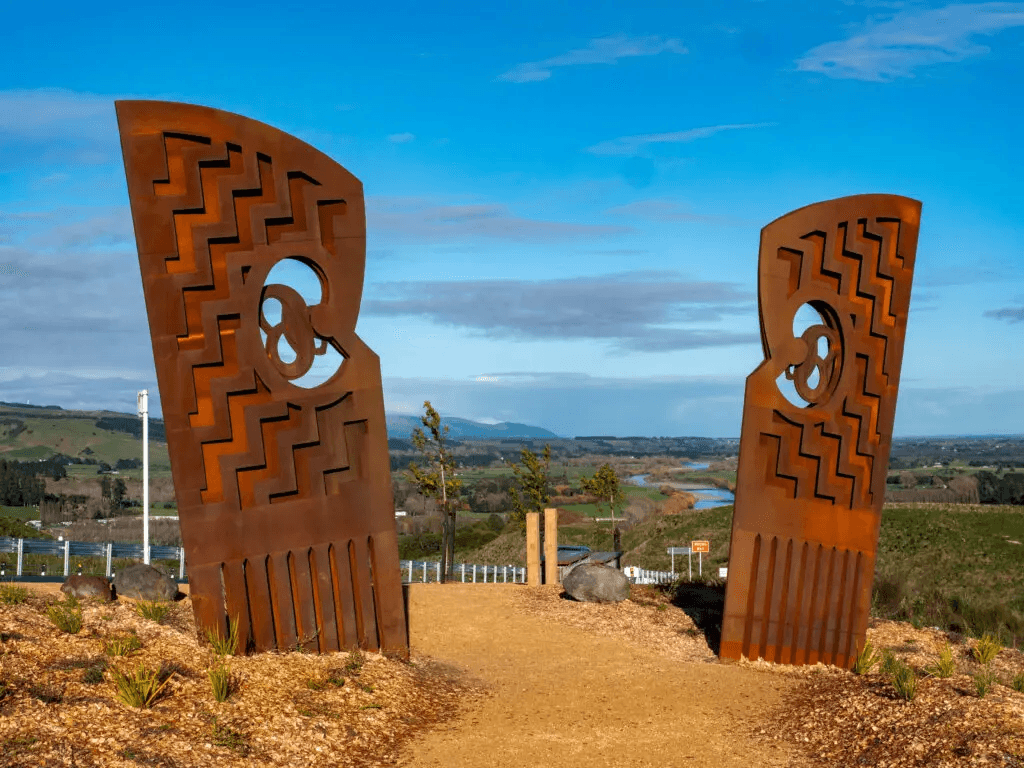
Be guided by Tohunga Toi Warren Warbrick (Rangitāne) and discover how the mahi toi (art and design elements), embedded in the Te Ahu a Turanga highway, which opened in June 2025, expresses relationships between the four Iwi involved in the project. Find out how the tools and techniques of working with harakeke (flax) inspired large sculptures and infrastructure design work. Hear Warren’s kōrero on site in the Parahaki Bridge vicinity, as well as the two highway lookouts. The Mātanga Mahi Toi of the project are Warren Warbrick (Rangitāne), James Molnar (Rangitāne) and Dr Sandy Adsett (Ngāti Pāhauwera).
This fieldtrip will leave from Massey University campus by bus and travel to the Te Ahu a Turanga highway returning to the campus.
3 hours leaving from Massey campus
Cost: $55
Wear good walking shoes and appropriate clothing for the 1km walking involved.
Landscapes, Leisure, and Empire: Palmerston North in Four Parks
Leaders: Prof Emeritus Michael Roche and Prof Juliana Mansvelt
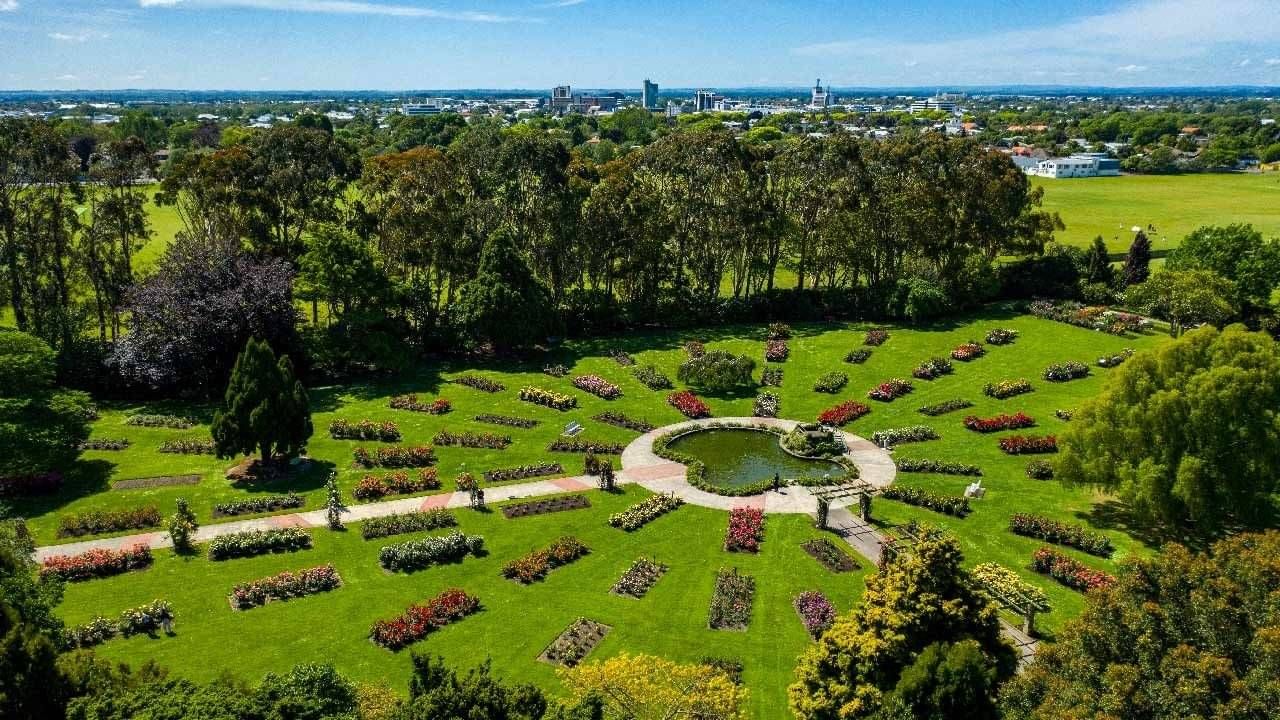
Palmerston North has more than 60 parks and reserves dating back to the early years of the borough in 1877. Some of these represented ‘beautification’ via the creation of gardens and planting of trees, others had more utilitarian purposes as playing fields, all were part of a suite of landscapes within the urban periphery. This tour of Victoria Esplanade, the former Anzac Park, Memorial Park, and Bledisloe Park provide a glimpse into the environment in which a colonial town was established and how particular sets of values were inscribed in the landscapes of these parks over successive decades (not least in the choice of names).
3 hours leaving from Massey campus
Cost: $35
Wear good walking shoes and appropriate clothing for the walking involved.
Savage Crescent Heritage Walking Tour
Leaders: Aisling Gallagher, Matt Henry
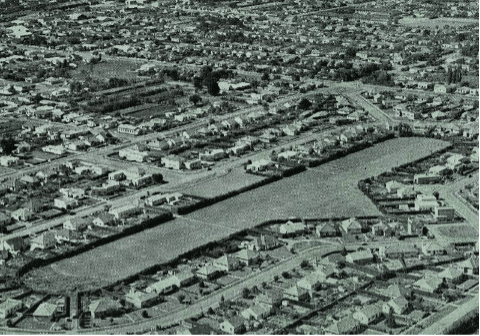
The Savage Crescent state housing precinct is in the West End area of Palmerston North. Fifty acres were bought by the Government for the development, and between 1939 and 1944, 245 state houses were built. It was New Zealand's first provincial state housing garden suburb, named after Prime Minister Michael Joseph Savage. Savage Crescent was designed upon the most modern ideas, as a garden suburb, with a large central, recreational area, communal garages and a variety of house designs built for the sun and with ample gardens. While the majority ofthe houses in Savage Crescent are now privately owned, the precinct remains as a significant example of state housing in New Zealand. In 1999 the Palmerston North City Council included the crescent as a heritage conservation area in its District Plan.
2 hours leaving from Massey campus
Cost: $45
Street Art on Scooters: Exploring Hopeful Spaces in Palmerston North
Leader: Prof Regina Scheyvens
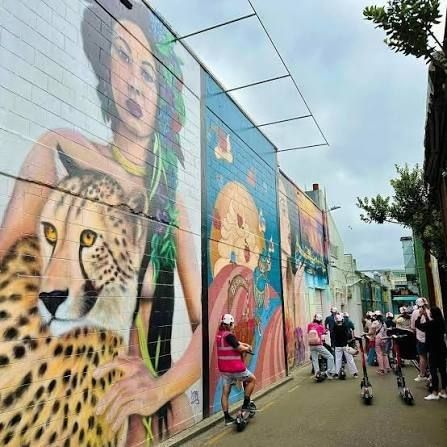
Discover Palmerston North from a different perspective as we zip through the city centre on e-scooters, stopping to explore vibrant murals and sculptures that tell stories of creativity, identity and hope. This fun, guided tour will provide a unique way of experiencing the urban landscape. Numbers are limited to 15, so book early!
3 hours leaving from Massey campus
Cost: $30
Suitable for able-bodied participants who are confident doing this on an e-scooter
New Zealand Geographical Society
General: admin@nzgs.co.nz
Membership: membership@nzgs.co.nz